 Raw Material Handling
 Dosing & Batching
 Pneumatic Conveying
 Filling & Packaging
 Control & Automation
 Equipment & Products
 Plastic
 Chemistry
 Mineral
 Food
Food
 Environment & Energy
 Project Management
 Systems Engineering
 Manufacturing & Factory Testing
 Control & Automation
 Installation & Commissioning
 Service & Spare Parts
 About Us
 Management Team
 Our Values
 Career
 Digital Library
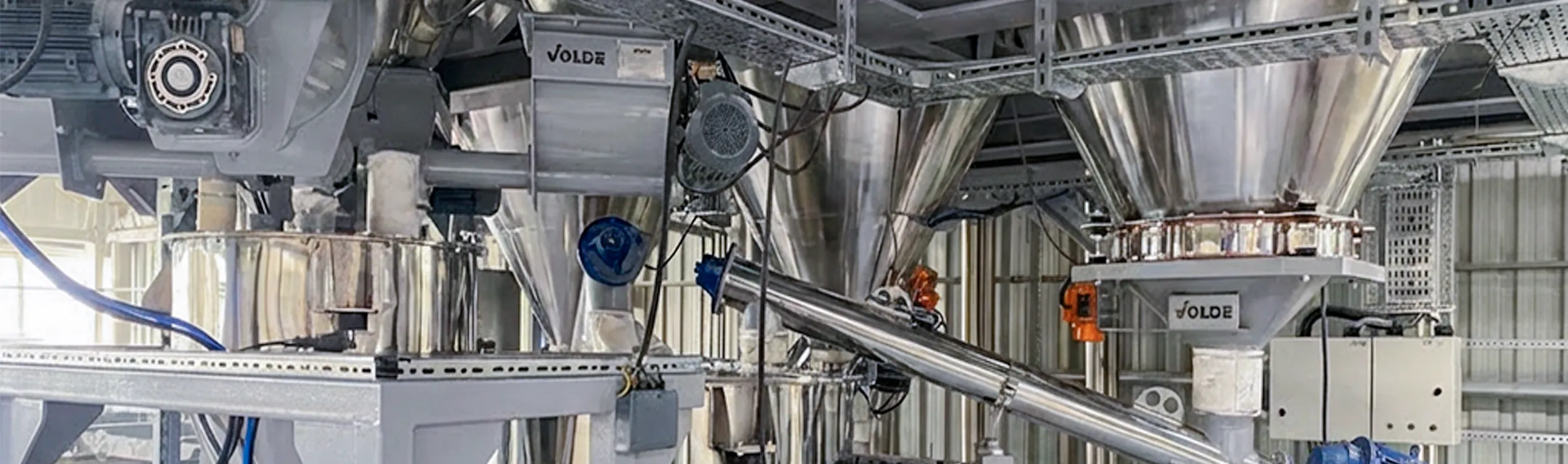

PVC Dry Blend Preparation & Mixer Feeding
PVC Dry Blend Preparation & Mixer Feeding
Formulation Accuracy for Consistent Cable Compounds
VOLDE develops complete raw material preparation and mixer feeding systems for PVC cable compounds used in insulation, sheathing and bedding applications. PVC resin, mineral fillers, plasticizers, stabilizers, lubricants, pigments and functional additives are stored, conveyed, weighed and introduced into the mixing process according to the formulation. Each system is engineered around the cable compound recipe, hot/cold mixer capacity and production cycle. Major ingredients, micro additives and liquid components are handled through dedicated process routes and brought together at the required stage of the mixing sequence, supporting repeatable dry blend preparation across different cable compound formulations
| Raw Material Storage & Handling
PVC cable compounds combine materials with very different physical characteristics. PVC resin and calcite are generally consumed in larger quantities, while pigments, stabilizers and processing additives require smaller and more flexible handling systems. Flexible PVC formulations also introduce significant quantities of plasticizers and other liquid components into the process.
Depending on plant logistics, PVC resin and mineral fillers can be stored in silos or supplied from big bags, while lower-consumption ingredients are introduced through bag dumping or dedicated additive stations. Fine powders such as micronized calcite, titanium dioxide and pigments may require different discharge and conveying arrangements because of their tendency to compact, adhere or generate dust.
Typical raw material handling can include
• PVC resin and calcite silos
• Big bag and bag discharge stations
• Vacuum or pressure pneumatic conveying
• Intermediate and mixer feed bins
• Plasticizer and liquid additive storage systems


| Major Ingredient Weighing
PVC resin and mineral fillers form the main part of most cable compound formulations and must be prepared in the correct proportions before mixer charging. Depending on plant configuration, these materials can be weighed through central batch weighing or vacuum weighing systems and transferred automatically to the mixer feed section.
Weighing capacity, hopper volume and conveying sequence are selected according to mixer batch size, raw material characteristics and production cycle. In multi-line plants, common raw material sources can supply different mixer lines through automated routing.
• Gravimetric batch weighing of PVC resin and fillers
• Central or vacuum weighing configurations
• Automatic material selection
• Target / actual weight monitoring
• Integration with mixer loading sequences


| Additives, Micro Ingredients & Plasticizers
The performance of insulation, sheathing and bedding compounds depends not only on the main raw materials but also on accurately managing stabilizers, lubricants, pigments, processing aids and other low-volume ingredients.
Minor and micro components can be dosed automatically or prepared through operator-guided weighing stations depending on consumption, formulation variety and required automation level. Liquid plasticizers and stabilizers are stored separately and introduced into the hot mixer at the appropriate stage of the recipe.
For difficult-to-handle materials such as fine pigments or certain stabilizer systems, feeder geometry and material intake equipment are selected specifically for the product rather than using a common dosing arrangement.
Typical solutions include automatic micro-dosing, gravimetric or volumetric feeders, manual micro weighing, pigment feeding and dedicated liquid weighing systems.


| Hot/Cold Mixer Feeding & Dry Blend Transfer
Mixer performance is influenced not only by formulation accuracy but also by the sequence and timing in which ingredients enter the process. VOLDE coordinates powder feeding, additive dosing and liquid addition with the hot mixer cycle so that each component is introduced at the required stage.
After hot mixing, the material is transferred to the cooling mixer and prepared for downstream handling. Finished cable dry blend can then be transferred directly toward extrusion or routed to intermediate silos that provide buffer capacity between mixing and production.
Vacuum, pressure or dense phase pneumatic conveying can be selected according to capacity, conveying distance and dry blend characteristics. In plants producing several cable compound grades, automatic routing can connect different mixer lines, intermediate silos and downstream production lines.

| Recipe Management & Production Traceability
Cable manufacturers frequently work with different insulation, sheathing and bedding formulations, colors and customer-specific compound grades. The automation system therefore manages not only equipment operation but also recipe selection, material identification and production history.
VOLDE PLC/SCADA automation coordinates raw material selection, weighing, micro-dosing, liquid dosing, mixer charging and dry blend transfer from a common control platform.
• Recipe and formulation management
• Batch-based target and actual weighing records
• Raw material, lot and consumption tracking
• Alarm and operator event history
• Production reporting and historical batch review
• ERP / MES integration


| Contact
Let us understand your process and work together to implement the most accurate and reliable solution for your needs.