 Raw Material Handling
 Dosing & Batching
 Pneumatic Conveying
 Filling & Packaging
 Control & Automation
 Equipment & Products
 Plastic
 Cable
Cable
 Chemistry
 Mineral
 Food
Food
 Environment & Energy
 Project Management
 Systems Engineering
 Manufacturing & Factory Testing
 Control & Automation
 Installation & Commissioning
 Service & Spare Parts
 About Us
 Management Team
 Our Values
 Career
 Digital Library

PVC Dry Blend Preparation
PVC Dry Blend Preparation
Precision in Every Batch. Performance in Every Mix
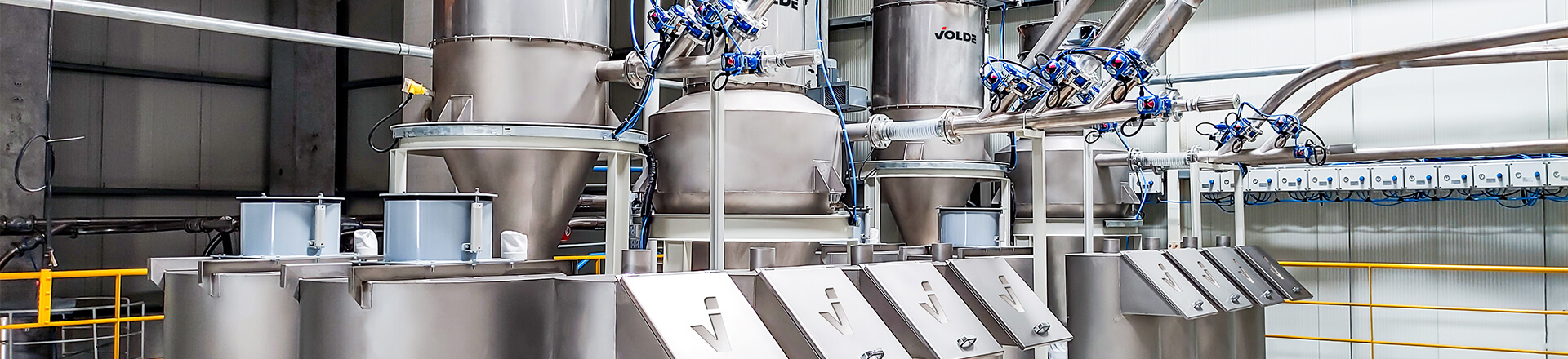
VOLDE PVC Dry Blend Preparation Systems integrate raw material storage, pneumatic conveying, weighing, additive dosing, mixer feeding, intermediate storage and extruder feeding within a complete process solution. Each plant is engineered around the PVC formulation, batch size, mixer capacity, raw material characteristics and required production flexibility. PVC resin, fillers, additives, pigments and liquid components are handled through dedicated process routes and introduced into the production sequence according to the recipe. Automated material handling and weighing reduce manual intervention, while PLC/SCADA-based process control provides repeatable batch preparation, recipe management and full production traceability. Systems can be configured for rigid and flexible PVC applications including profiles, pipes and fittings, cables, hoses, flooring, films, sheets and other PVC compounds.
| Raw Material Storage & Mixer Feeding
A reliable PVC dry blend process begins with the correct handling of each raw material. Major components such as PVC resin and mineral fillers can be received from bulk tankers, big bags or bags and transferred to silos, storage bins or day bins according to plant requirements.
Each material is evaluated individually when selecting the conveying technology. PVC resin and suitable fillers can be transferred through vacuum, pressure or dense phase pneumatic conveying systems, while highly adhesive or abrasive materials such as titanium dioxide may require dedicated conveying routes and equipment.
Raw materials are automatically supplied to the weighing and mixer feeding system according to production demand.
_Typical Raw Materials
• PVC resin – K values according to formulation
• Calcium carbonate (CaCO₃)
• Titanium dioxide (TiO₂)
• Talc and mineral fillers
• Stabilizers and processing aids
• Impact modifiers
• Pigments and colorants
• Rework and recycled PVC
_System Solutions
• Bulk tanker unloading and silo filling
• Big bag discharge systems
• Bag dumping stations
• Raw material silos and day bins
• Vacuum pneumatic conveying
• Pressure and dense phase conveying
• Centralized mixer feeding
• Automatic material and conveying-line selection
• Multiple mixer line feeding


| Major, Minor & Micro Ingredient Dosing
PVC formulations can contain components ranging from several hundred kilograms of PVC resin and filler to very small quantities of stabilizers, modifiers, pigments, waxes and processing aids. VOLDE combines different weighing and dosing technologies within the same plant according to ingredient quantity, flow behavior and required weighing resolution.
Major components can be automatically weighed in central or vacuum weighing systems. Medium-volume additives are supplied from dedicated bins or bag intake stations and dosed through material-specific feeders. Small and micro ingredients can be handled through automatic micro dosing systems or operator-guided manual weighing stations.
Liquid components such as plasticizers can be stored, weighed and automatically introduced into the hot mixer at the required stage of the recipe.
Dosing & Ingredient Handling
• Gravimetric weighing of PVC resin and fillers.
• Automatic dosing of stabilizers and processing aids.
• Precise feeding of pigments and modifiers.
• Automatic and manual micro ingredient preparation.
• Liquid plasticizer dosing
• Recipe-controlled ingredient selection
• Rework weighing and return to production
• Target / actual weight monitoring
• Batch and raw material consumption records
The dosing architecture is developed around the formulation rather than applying the same feeding principle to every ingredient.


| Dry Blend Handling & Extruder Feeding
After the heating and cooling mixer process, finished PVC dry blend can be transferred directly to production or routed to intermediate storage depending on the plant layout and production strategy.
Intermediate silos provide buffer capacity between mixing and extrusion and allow several mixer and production lines to operate with greater flexibility. Where required, blending or homogenization systems can be incorporated to support consistent material properties before downstream processing.
From the storage silos, dry blend is distributed to extruders through centralized pneumatic conveying systems. Depending on capacity, conveying distance and material behavior, vacuum or pressure conveying technologies can be applied.
A centralized distribution concept allows different silos to serve different extrusion lines, providing greater flexibility for plants producing multiple PVC formulations.
Downstream Integration.
• Dry blend transfer from mixer discharge.
• Intermediate and buffer silos.
• Blending and homogenization silos.
• Centralized extruder feeding.
• Vacuum conveying to production lines
• Pressure or dense phase conveying for higher capacities and longer distances
• Automatic silo-to-extruder routing
• Multiple silo / multiple extruder configurations
• Level monitoring and demand-based feeding


| Process Automation, Recipe Management & Traceability
The complete PVC dry blend plant is coordinated through a central PLC/SCADA automation system. Raw material selection, conveying routes, weighing sequences, mixer feeding, intermediate storage and downstream transfer are managed as a connected production process.
Recipe parameters define which ingredients are required, their target quantities and the sequence in which they are introduced. Actual weighing results, raw material consumption, batch information, alarms and production events can be recorded automatically to create a complete production history.
Integration with ERP or MES platforms allows production orders, recipes and material information to be exchanged with higher-level systems while actual consumption and batch results are returned from the plant.
Automation & Production Data.
• PLC-based process sequencing.
• SCADA/HMI visualization.
• Recipe and formulation management.
• Automatic material and route selection.
• Batch tracking and traceability
• Target / actual weighing records
• Raw material consumption monitoring
• Lot and material identification
• Alarm and event history
• Production and batch reporting
• ERP / MES integration
• Remote diagnostics and service access


| PVC Dry Blend Applications
Rigid PVC — PVC-U
• Window and door profiles
• Pipes and fittings
• Technical profiles
• Rigid sheets and boards
• Foamed PVC products
• Injection molding compounds
• PVC flooring and SPC formulations
Flexible PVC — PVC-P
• Cable insulation and sheathing compounds
• Hoses and flexible profiles
• Flooring and flexible sheets
• Flexible films
• Injection molding compounds
• Edge banding
• Plasticized PVC compounds


| Contact
Let us understand your process and work together to implement the most accurate and reliable solution for your needs.