 Raw Material Handling
 Dosing & Batching
 Pneumatic Conveying
 Filling & Packaging
 Control & Automation
 Equipment & Products
 Plastic
 Cable
Cable
 Chemistry
 Mineral
 Food
Food
 Environment & Energy
 Project Management
 Systems Engineering
 Manufacturing & Factory Testing
 Control & Automation
 Installation & Commissioning
 Service & Spare Parts
 About Us
 Management Team
 Our Values
 Career
 Digital Library

Insulating Refractory Mix Preparation
Insulating Refractory Mix Preparation
Controlled Batching for Lightweight Insulating Refractories
Insulating refractory products are formulated to combine low density with controlled thermal performance under high-temperature conditions. Their recipes may include expanded mineral aggregates, refractory powders, binders and functional additives with significantly different bulk densities, particle structures and flow characteristics. VOLDE designs automated raw material handling and batching systems specifically for these formulations. Storage, feeding, dosing and batch preparation are configured according to the behaviour of each ingredient, with particular attention to accurate recipe execution and careful handling of fragile materials.
| Raw Material Storage & Feeding
Insulating refractory formulations may include perlite, vermiculite, lightweight chamotte, expanded mineral aggregates, microsilica, binders and formulation-specific additives.
These materials can behave very differently from dense refractory minerals. Some are porous and fragile, while others are fine powders with poor flow characteristics or a strong tendency to generate dust.
VOLDE therefore determines the storage and discharge concept individually for each raw material. Bin geometry, discharge equipment and feeder technology are selected according to bulk density, particle size and flow behaviour.
Load cells can be used for bin inventory monitoring, while screw feeders, vibro feeders or other dosing equipment are selected according to the required capacity and weighing range.

| Recipe-Controlled Dosing & Batch Preparation
The performance of an insulating refractory formulation depends on maintaining the correct ratio between aggregates, fine powders, binders and functional additives.
The PLC-controlled batching system automatically selects the required raw materials and doses each ingredient according to the active recipe. Target and actual weights are monitored throughout the sequence, and the complete batch can be verified before transfer to the next production stage.
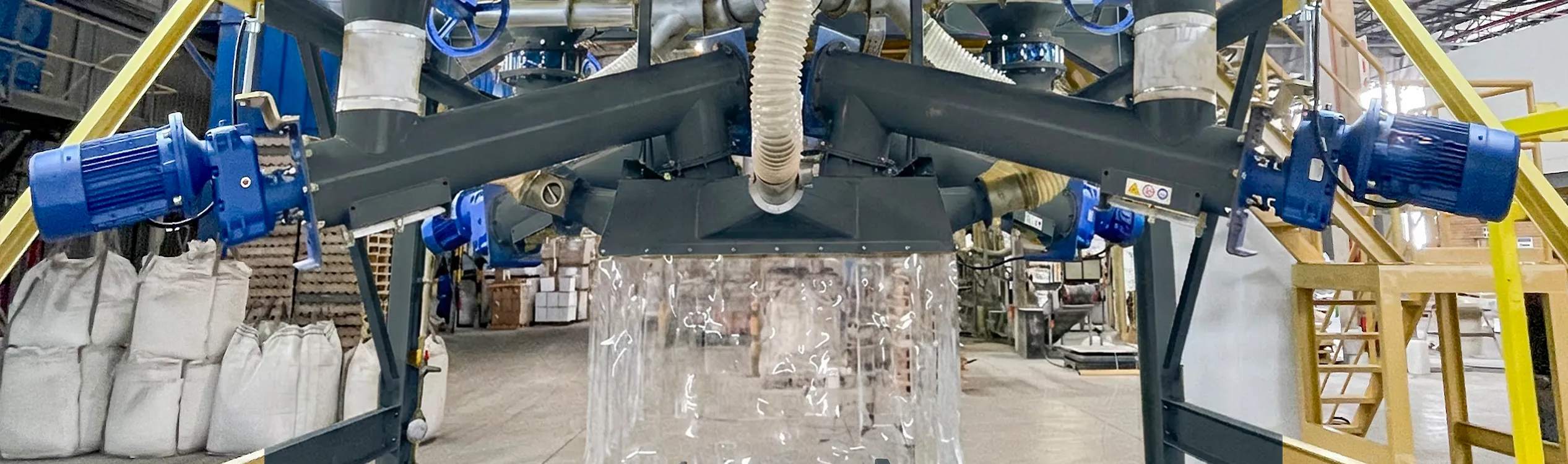
In a VOLDE reference project, four dedicated raw material bins are used for the principal fractions. Each storage and dosing unit is configured according to the physical characteristics of the material it handles.
This structure allows different insulating refractory formulations to be prepared through the same production infrastructure while maintaining controlled and traceable recipe execution.

| Gentle Handling of Lightweight & Porous Aggregates
Expanded minerals and porous aggregates can be sensitive to impact, excessive conveying velocity and aggressive mechanical handling. Particle degradation during feeding or transfer may alter the characteristics of the material before it reaches the downstream process.
For this reason, VOLDE considers material velocity, drop heights, feeder operation and transfer geometry together during system design.
Low-speed feeding and controlled transfer are applied where required to reduce mechanical stress on sensitive aggregates. Fine binders and low-quantity additives can be handled through separate dosing arrangements selected according to their own flow behaviour and accuracy requirements.
The objective is to prepare the required formulation while preserving the physical structure of lightweight and porous raw materials throughout the handling process.
| Protect the Structure Before the Product Is Made
In insulating refractory production, accurate weighing alone is not enough. Low-density and porous raw materials must also retain their physical characteristics during storage, feeding and transfer.
VOLDE combines material-specific handling with controlled batching to create preparation systems suited to the particular requirements of insulating refractory production.
| Automation, Dust Control & Traceability
Fine refractory powders and expanded mineral products can generate considerable dust during filling, dosing and transfer. The preparation system can therefore be integrated with a central dust collection network, with extraction points positioned at the main material handling areas.
PLC/SCADA automation manages recipe selection, dosing sequences, weighing values and batch records. Production data can be stored, monitored and reported for subsequent analysis.
The system can include
• Recipe and batch tracking
• Target and actual weighing records
• Raw material consumption monitoring
• Production history
• Alarm and operator records
• ERP and quality-system integration
VOLDE combines material-specific storage, precise dosing, gentle handling and process automation to create batching systems tailored to lightweight insulating refractory formulations.


| Contact
Let us understand your process and work together to implement the most accurate and reliable solution for your needs.