 Raw Material Handling
 Dosing & Batching
 Pneumatic Conveying
 Filling & Packaging
 Control & Automation
 Equipment & Products
 Plastic
 Cable
Cable
 Chemistry
 Mineral
 Food
Food
 Environment & Energy
 Project Management
 Systems Engineering
 Manufacturing & Factory Testing
 Control & Automation
 Installation & Commissioning
 Service & Spare Parts
 About Us
 Management Team
 Our Values
 Career
 Digital Library

Tea Blending & Recipe Preparation
Tea Blending & Recipe Preparation
The Taste of Tea Is Shaped Before Blending Begins
The final taste of tea depends not only on leaf quality, but also on how different tea types are selected and brought together. Leaf structure, aroma profile, harvest period and fine-particle content can vary significantly between teas. The May harvest, regarded as the most valuable picking period in Turkish tea production, therefore occupies a distinct place in many blend formulations. VOLDE designs complete tea blending plants around this variability. Big bag unloading, type-specific storage, weighing, recipe preparation, conveying and automation are arranged as one coordinated process rather than as a collection of independent machines. The number of tea types, production capacity, blend logic and packaging-line demand define the final architecture. This approach is backed by turnkey blending installations delivered for three of Turkey’s leading tea producers, where high-capacity dry tea handling and recipe execution form the core of the process.

| Multi Storage & Recipe Flexibility
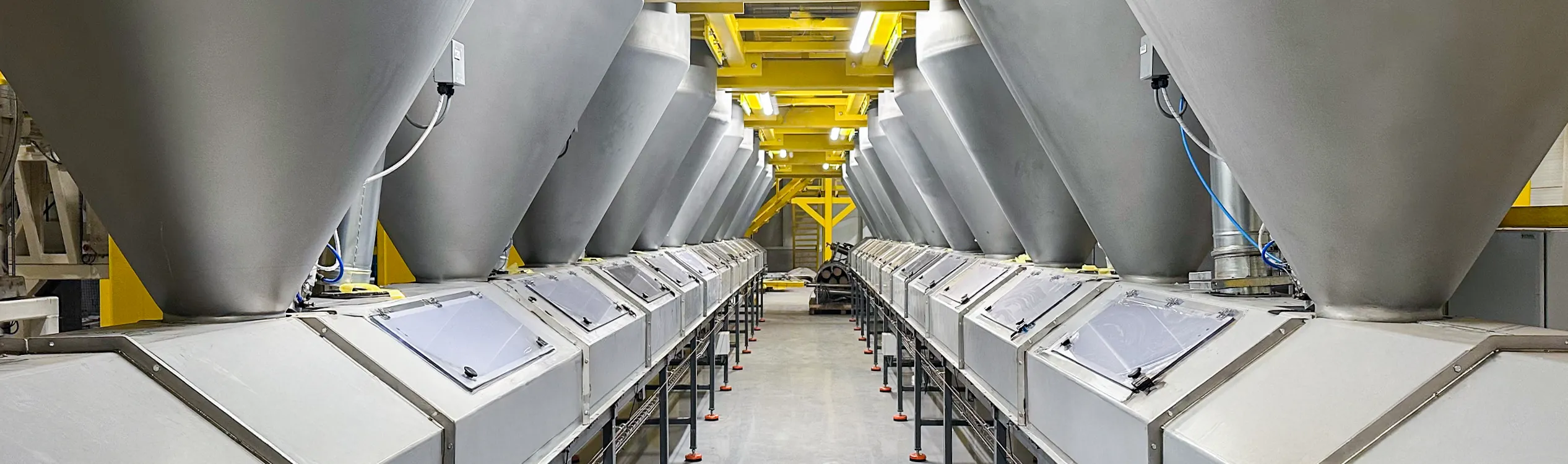
A broad tea portfolio starts with keeping the raw materials available as distinct, identifiable streams. Tea arriving at the plant can be separated by leaf structure, origin, harvest period or quality profile and assigned to dedicated bins. The storage layout is then configured around the producer’s recipe strategy: some bins may be reserved for core teas, others for seasonal or specialty types, while future products can be accommodated without rebuilding the entire preparation line.
Big bag feeding, level monitoring and automatic source selection are integrated into this storage concept. The benefit is operational flexibility: different commercial blends can be prepared from the same infrastructure while each tea type remains clearly identified up to the weighing stage.


| Gravimetric Weighing & Automatic Blend Preparation
When a recipe is released, the process moves from storage logic to formulation. The PLC calls the required tea types from their assigned bins, controls the target weights and determines the weighing sequence. Collected quantities are discharged onto the blending route only after the programmed targets have been reached.
Parallel collection lines can be used where throughput demands it, while fannings, fine tea fractions or powdered flavour ingredients may enter the recipe through separate dosing points. Magnetic separation and batch verification can be positioned where required. In this way, weighing is not treated as a stand-alone step; it becomes the point where recipe data is converted into a physical blend.


| Gentle Conveying from Blending to Packaging
Once the blend has been prepared, the priority changes: the product now has to reach the next stage without unnecessary leaf breakage. High impact, excessive speed and poorly designed transfer points can change particle-size distribution and increase fines.
For this reason, the conveying method is selected from the product backward. Low-impact pneumatic conveying may suit one layout, while food-grade chain conveyors, bucket elevators or belt systems may be more appropriate in another. Route geometry, transfer height and equipment speed are considered together so that capacity is achieved without treating tea like an ordinary bulk solid.


| The Same Taste in Every Blend
Harvest periods change, tea types vary and production volumes rise or fall. The target taste profile, however, must remain recognizable from one production run to the next. Recipe control, weighing accuracy and careful product handling all serve this single objective.
| Food Grade Design, Automation & Traceability
Hygienic product handling and reliable production records are designed into the plant from the beginning. Product-contact parts are selected for food applications, enclosed transfer points and dust extraction are added where the process requires them, and cleaning access is considered alongside mechanical layout.
PLC/SCADA connects the physical plant with production data. Recipe selection, target and actual weights, tea consumption, batch identity, alarms and raw-material inventory can be followed from the same control environment. Where plant systems require it, production information can also be exchanged with ERP, inventory or quality platforms.
The result is a blending plant in which storage flexibility, gravimetric preparation and gentle conveying support both a broad recipe portfolio and the physical integrity of the tea.


| Contact
Let us understand your process and work together to implement the most accurate and reliable solution for your needs.