 Raw Material Handling
 Dosing & Batching
 Pneumatic Conveying
 Filling & Packaging
 Control & Automation
 Equipment & Products
 Plastic
 Cable
Cable
 Chemistry
 Mineral
 Food
Food
 Environment & Energy
 Project Management
 Systems Engineering
 Manufacturing & Factory Testing
 Control & Automation
 Installation & Commissioning
 Service & Spare Parts
 About Us
 Management Team
 Our Values
 Career
 Digital Library

Latex-Based Protective Coating Production
Latex-Based Protective Coating Production
Effective Dispersion. Better Coating Quality
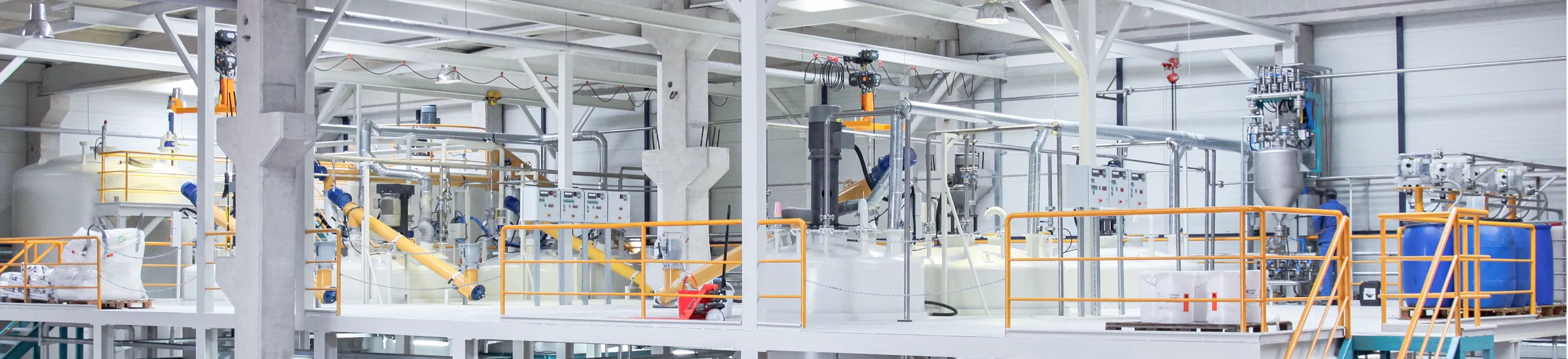
Latex-based protective coatings combine imported latex binders with liquid additives, pigments, mineral fillers and formulation-specific powder ingredients. Because these components differ significantly in viscosity, density, flow behavior and sensitivity to shear, the quality of the final coating depends on how they are transferred, dosed and introduced into the mixing process. VOLDE develops complete production systems covering latex unloading, liquid and powder additive dosing, controlled dispersion, final mixing and finished-product transfer. Each plant is engineered around the formulation, mixer technology, batch size, viscosity range and required production capacity
| Latex Handling & Liquid Additive Dosing
Imported latex can be received through flexitanks, IBCs or other suitable containers and transferred to dedicated process or storage tanks. Because latex dispersions can be sensitive to excessive shear and foaming, pump selection, transfer velocity and piping design are considered together.
VOLDE uses suitable diaphragm or low-shear pumping solutions where required, while the transfer system is designed according to viscosity, chemical compatibility and production rate.
Liquid formulation components supplied from drums or IBCs can be prepared through dedicated weighing or dosing systems before being transferred to the mixer.
Typical liquid ingredients may include
• Latex and polymer dispersions
• Wetting and dispersing agents
• Defoamers
• Thickeners
• pH-adjusting chemicals
• Preservatives
• Coalescents and other formulation-specific additives
Load-cell weighing, flow measurement or suitable dosing pumps can be selected according to the required accuracy and liquid characteristics.


| Powder Feeding, Dispersion & Mixing
Pigments and mineral fillers must be incorporated into the liquid phase with sufficient wetting and dispersion while avoiding unnecessary dust generation or agglomeration. In water-based coating processes, pigment and filler dispersion is one of the key stages in achieving a stable and homogeneous formulation.
VOLDE integrates bag dumping stations, big bag discharge systems, weighing equipment and screw or suitable powder feeders with the mixer or disperser. Higher-consumption fillers such as calcium carbonate can also be supplied from silos where production capacity requires centralized storage.
Typical powder ingredients may include calcium carbonate, titanium dioxide, pigments, rheology modifiers and other formulation-specific fillers or additives.
Mixer and disperser selection is based on the actual product rather than a single standard configuration. Addition sequence, agitator speed, shear level and mixing time can be controlled according to the active recipe, allowing powders to be wetted and dispersed before final formulation adjustment.


| The Right Sequence Creates the Right Coating
A coating formulation is not defined only by ingredient quantities. The order in which latex, liquids, pigments and fillers enter the process — and the shear applied at each stage — has a direct influence on dispersion quality, viscosity and final product stability.


“Precision Mixing for Perfect Coatings”
Consistency and engineering assurance at every process step, from raw material acceptance to filling.
| Finished Product Handling & Flexible Production
After dispersion and final mixing, the finished coating can be transferred to dedicated product tanks or directly to the required filling point. Depending on customer logistics, the system can be configured for IBC filling, drum filling or tanker loading.
The complete production line can be managed through a common PLC/SCADA architecture, with recipe selection, weighing values, mixer parameters, production quantities and batch records monitored from a central system.
The same process platform can also be adapted to related water-based products such as.
• Acrylic and SBR-based binders
• Polymer dispersions
• Textile and nonwoven coating compounds
• Carpet and artificial-turf backing products
• Water-based primers and protective coatings
• Selected adhesive and binder formulations
VOLDE combines latex handling, liquid and powder dosing, controlled dispersion, mixing and finished-product transfer into one integrated production system developed around the actual coating formulation.


| Contact
Let us understand your process and work together to implement the most accurate and reliable solution for your needs.