 Raw Material Handling
 Dosing & Batching
 Pneumatic Conveying
 Filling & Packaging
 Control & Automation
 Equipment & Products
 Plastic
 Cable
Cable
 Chemistry
 Mineral
 Food
Food
 Environment & Energy
 Project Management
 Systems Engineering
 Manufacturing & Factory Testing
 Control & Automation
 Installation & Commissioning
 Service & Spare Parts
 About Us
 Management Team
 Our Values
 Career
 Digital Library

Powder Additive Dosing
Powder Additive Dosing
Small Quantities. Critical Influence on Compound Performance
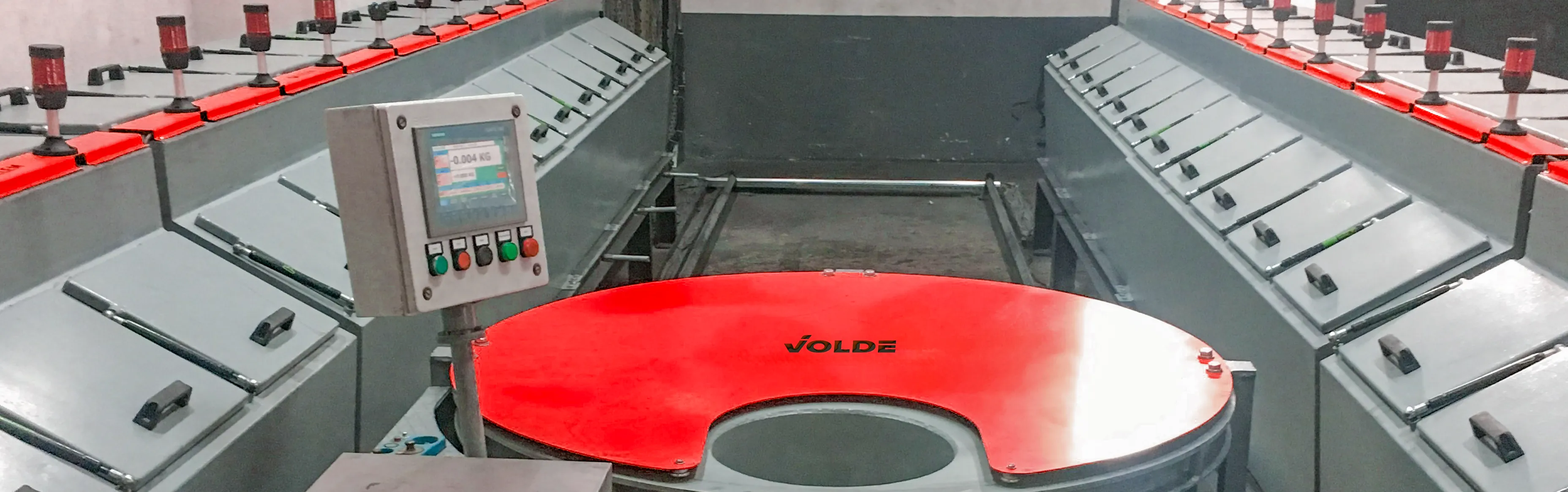
Powder chemical additives may represent only a small fraction of a rubber formulation, yet they have a major influence on vulcanization behaviour, processing characteristics, ageing resistance and final compound performance. Ingredients such as zinc oxide, sulfur, stearic acid, accelerators, antioxidants, antiozonants, curing agents and processing aids therefore require accurate preparation and clear recipe control. VOLDE develops both operator-guided manual weighing stations and fully automatic dosing systems for powder additives used in rubber and tire mixing rooms. Each solution is configured according to the number of ingredients, batch size, required accuracy, material flow behaviour and the Banbury production sequence
| Recipe-Guided Manual Powder Additive Weighing
Rubber mixing rooms often work with a broad portfolio of chemical additives, many of which are consumed in relatively small quantities and may change frequently between compound recipes. In these applications, operator-guided weighing provides flexibility while keeping the preparation process under digital recipe control.
VOLDE weighing stations guide the operator ingredient by ingredient according to the active formulation. The required material, target quantity and permissible tolerance are displayed at each step, and the measured value can be verified before the ingredient is accepted into the batch.
Typical ingredients may include zinc oxide, sulfur, stearic acid, TBBS, CBS, MBTS and other accelerators, antioxidants such as 6PPD and TMQ, antiozonants, retarders and other compound-specific powder chemicals.
Prepared materials can be collected in identified bags, containers or batch sets for transfer to the Banbury charging area.
• Recipe-guided ingredient selection
• Target / actual weight verification
• Configurable weighing tolerances
• Ingredient and batch identification
• Barcode or label integration where required
• Operator and weighing records
• Batch preparation linked to the production schedule
The result is a flexible preparation method that preserves operator involvement while reducing dependence on handwritten recipes and manual cross-checking.

| Automatic Powder Additive Dosing
For higher production volumes, repeated formulations and larger numbers of batches, powder chemical additives can be stored in dedicated small-volume hoppers and automatically dosed according to the active compound recipe.
Because rubber additives differ significantly in bulk density, particle size and flow behaviour, feeder technology is selected individually for each material. Free-flowing powders, cohesive ingredients and low-dose chemicals may require different screw geometries, vibratory feeders or discharge-assistance systems.
Automatic systems can sequentially dose multiple ingredients into a common weigh hopper, batch container or dedicated collection vessel before the complete additive set is transferred toward the mixing line.
Typical automatically dosed materials may include zinc oxide, sulfur, stearic acid, accelerators, antioxidants, antiozonants, processing aids, retarders and selected curing chemicals.
• Multiple additive storage hoppers
• Gravimetric batch weighing
• Screw or vibratory dosing according to material
• Coarse / fine dosing where required
• Automatic recipe execution
• Target / actual weighing control
• Batch container or bag preparation
• Dust extraction at dosing and weighing points
• ATEX / Ex configurations according to project requirements
VOLDE automatic powder-additive systems are developed around the actual Banbury recipe and batch sequence, providing repeatable preparation of low-dose chemical components before mixer charging.

| Systems Used

| Contact
Let us understand your process and work together to implement the most accurate and reliable solution for your needs.